
Political campaigns · 2026
Four campaign websites in a single election cycle
Four candidates needed a credible website against a deadline printed on the ballot. Two shipped in two days, two in about a week, and all four candidates won.
A deadline that does not move
Almost every website deadline is soft. A nonprofit’s relaunch slips a fortnight and nothing happens. A hospital’s microsite misses a quarter and the world turns.
A campaign has one real date on it, and it is printed on the ballot. A site that is beautiful on the Wednesday after the election is worth nothing at all. Candidates also tend to decide they need a website late, once door-knocking has started and somebody asks where people can donate — which is how four separate campaigns in one cycle each arrived with very little usable time.
All four shipped. All four candidates won.
What was built
Four one-page sites, each carrying the same working parts: the candidate’s case, their priorities, a donation route, a way to volunteer, and a contact form that actually delivers.
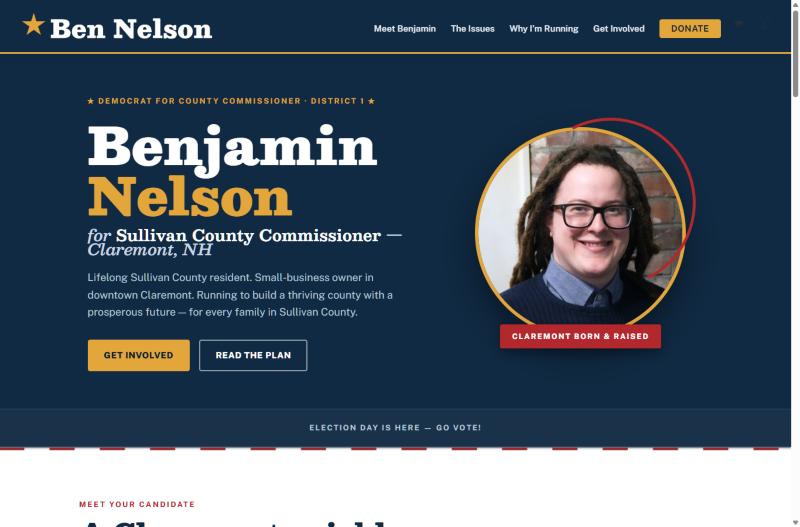 Benjamin Nelson — Sullivan County Commissioner, District 1. Built in WordPress and Divi.
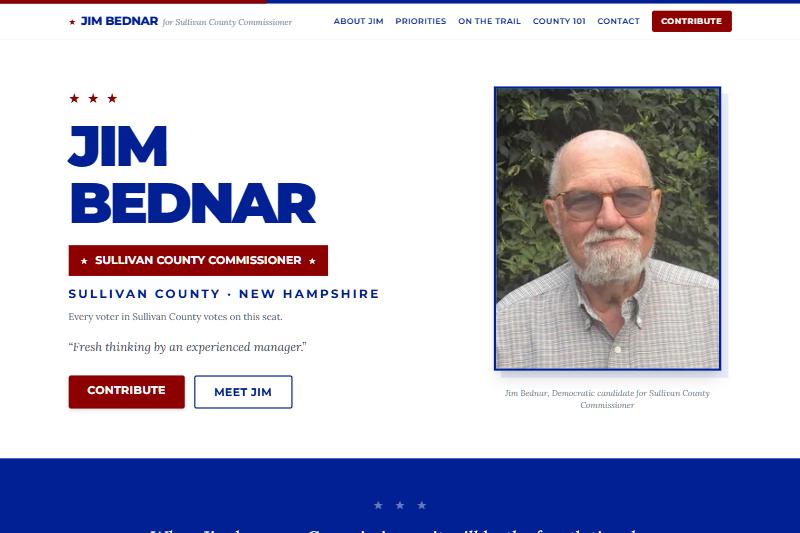 Jim Bednar — Sullivan County Commissioner, a seat every voter in the county votes on.
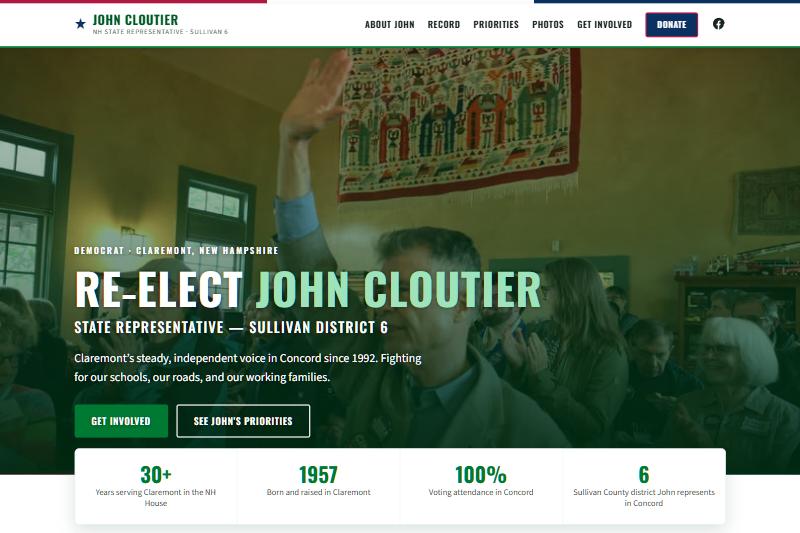 John Cloutier — New Hampshire State Representative, Sullivan District 6, in the House since 1992.
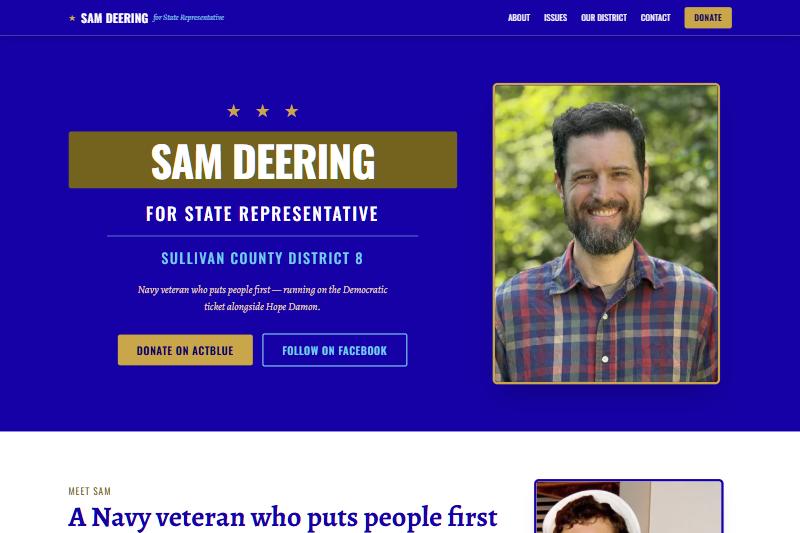 Sam Deering — New Hampshire State Representative, Sullivan County District 8.
Three were built on the Astro stack we use for most work. Benjamin Nelson’s was built in WordPress and Divi, because that was what suited the campaign. Picking the stack to fit the client rather than the studio is the whole point: there is never enough time in a campaign to also run a migration argument.
The timings
The Cloutier and Deering sites each went from nothing to live in two days. Bednar took about a week. Nelson also took about a week, most of the difference being time lost to DNS problems at the registrar rather than to the build.
That last one is worth keeping in the record rather than rounding away. On a deadline this hard, the risk is rarely the code. It is a domain that will not propagate, a donation platform that needs a verification step nobody mentioned, or a photo that arrives at the wrong size the night before. Most of the skill is in leaving room for those.
What the candidate said
Sam Deering, whose site went live in two days:
“I’m an artist by trade — I make pottery. I thought, how hard can it be to build a website? It turns out, very hard. I found I just couldn’t make something that looked good, and I didn’t have the time. Joshua Nelson produced something in 48 hours that not only looked good but was perfect for our needs.”
That is the actual shape of the problem, and it is not only a campaign problem. Capable people assume a website is a small thing until they try to make one, and then lose a fortnight to it — a fortnight they needed for the work they are actually good at.
What it does and does not prove
All four candidates won: two Sullivan County Commissioners and two State Representatives. One was an incumbent being re-elected; the other three were challengers who unseated sitting officeholders.
The websites did not win those elections. Candidates, volunteers and voters did. What this does show is that none of these campaigns was held back by its web presence at the point it mattered — and that work produced in two days stood up in public, under scrutiny, against opponents actively looking for weaknesses.
One disclosure: Benjamin Nelson is my son. The other three candidates are not family.
Why it is here
Institutional buyers — hospitals, school districts, municipalities, grant-funded programs — screen for one thing above almost everything else: will this person deliver on the date they promised? Most portfolios answer that with adjectives.
This one answers it with four fixed, externally verified deadlines in a single autumn, none of them missed, two of them met in forty-eight hours.